Announcing our new Rector!
The Reverend Eleanor Applewhite Terry has accepted the call to become the 5th Rector of our beloved Church of the Good Shepherd!

The Reverend Eleanor Applewhite Terry
The Wardens and Vestry are delighted to announce that The Reverend Eleanor Applewhite Terry has accepted the call to become the 5th Rector of our beloved Church of the Good Shepherd, Acton! Ellie will be joining us on or after October 1, 2020. Ellie comes to us from the Old North Church in Boston, where she has served on the clergy staff since 2013, first as Associate Vicar, and then in 2019, as Bridge Vicar. In this current role, she has sole responsibility for parish services, ministries, and administration, all the while supporting that parish during a transitional period as they prepare to welcome a new Vicar.
Our new Rector also served for seven years as the Vicar of St. Paul's Church in Plainfield, Connecticut, and began her ordained ministry as the Associate Rector of Saints Peter & Paul Church in Portland, Oregon. These two parishes gave her diverse experiences: one a family-oriented, small community parish where she was instrumental in growing average Sunday attendance by 86%; the other an urban congregation with exquisite liturgy and a strong commitment to outreach.
Ellie earned a M.Div. from Yale Divinity School in 1997 (Diploma of Anglican Studies, Berkeley Divinity School at Yale) and a B.A. from Smith College in 1991, with a Major in Religion and Biblical Literature and a Minor in Government.
Ellie has actually been among us in the Acton community for some time: she and her family have lived in Acton since 2012! Some of you might already know Ellie and her family from school and other activities.
The Wardens and Vestry are extremely appreciative of the dedicated and discerning work of the Rector Search Committee over these past months and years. Thank you for your good and faithful service! Please join with the Wardens and Vestry in sharing a big WELCOME to Ellie as she prepares to join the Church of the Good Shepherd faith community!

The Rev. Melissa Buono
Sermon for the fourth Sunday after Pentecost, June 28, 2020
Sermon for the Fourth Sunday after Pentecost 6.28.2020
Church of the Good Shepherd, Acton, Massachusetts
Rev. Melissa Buono, Interim Priest
Readings: Jer. 28:5-9; Ps 89:1-4,15-18; Romans 6:12-23; Matthew 10:40-42
Welcome back to the final installment of Jesus’ “Missionary Discourse” “How to Follow Jesus,” brought to you by Matthew Chapter 10.
The first installment was a lesson in Jesus showing his disciples how it’s done - moving from town to town and sharing the message of God’s love and mercy, and having compassion on God’s people by feeding and healing them and tending to their needs.
Having shown them, Jesus then sent out his followers, called Apostles meaning “those sent out” to go out and follow his example. They were to take no payment for their service, bring no bag of coins, no extra clothes, sandals or staff. They were sent out as sheep in the midst of wolves.
The second installment brought understanding that they would be rejected by some people, mocked and criticized by others, but through it all they need not fear. God would be their rod and their staff along the way. But they should be forewarned that the message of salvation that they bring to the weak and the marginalized will cause your closest relationships to be challenged, father and son, mother and daughter, as those who challenge you will likely be members of your own household.
And finally in this last bit, the last couple of verses of Matt. chapter 10, we learn a little something about hospitality.
At first read, this week’s Gospel lesson might sound like a directive to simply be hospitable to others by serving them with a cup of cold water on a hot muggy day or with a cup of hot coffee with steamed milk on a beautiful Sat. morning, for doing so will bring great reward. However, that’s not where Matthew has Jesus go with this teaching.
A closer reading of the text says, “whoever welcomes you welcomes me, and whoever welcomes me welcomes the one who sent me.”
Did you catch that subtle difference? It’s not asking you or me to welcome others, but it’s charging us to be the ones welcomed by those willing to accept the message of God’s love for the building up of God’s kingdom on earth.
If you think about it, the whole text has been about what Jesus’ disciples should expect when they are sent out as sheep among wolves. So far, Jesus has been teaching the warnings of what to expect the reaction of some people to be. But in this lesson, Jesus speaks of the promise that is to come for one who is faithful in bringing the message of God’s kingdom.
And the promise is connected to the ancient understanding of hospitality. Throughout the Bible, the gift of showing hospitality especially to the stranger in your village was very important. No one was ever to be left outside to sleep in the town square. Doing so, would leave one vulnerable to the bandits and thieves who were most active at night.
The thing is, in the ancient world, there’s no such thing as the “rugged individual” that we know today. Instead one’s identity was connected to one’s family and the community in which one lived. Therefore, it was understood that in showing hospitality, one welcomed not just an individual, but wholeheartedly accepted the community who sent the person and all that they represent. The connection being that those who welcomed a disciple of Jesus, welcomed the very presence of Jesus as well as God, the Father who sent him to earth in the first place.
This passage therefore is speaking about the people that do the welcoming to you and to me and to all Jesus’ followers. We are not the ones welcoming anyone, instead it is about the disciples being welcomed by others. They and we, are to go out and preach like the prophets of old, bringing a word of God’s love, and in turn they will receive a prophet’s reward.
Here we must ask ourselves, what is a prophet’s reward?
Think about John the Baptist. He was sent as a prophet to prepare the way for Jesus’ coming. What happened to him when he took on the King and pointed out his adulterous behavior? His head was cut off.
Think about the prophets of the Old Testament? How was Moses received by Pharaoh when he came with a message from God to let God’s people go? Let the slave labor that was enriching Egypt’s economy go free? He was told no, and no, and no again - that was until God made it clear who Pharaoh was really dealing with.
What of Ezekiel, Isaiah, Jeremiah, Amos? Each one faced very difficult challenges because they brought a message that was not all peaches and cream. Their calling, their mission was to speak to God’s people to remind them of their sin and call them back to relationship with God. How popular do you think the prophets were in their time?
The reward of the prophet is not welcome parades and be pampered with hospitality. The reward of the prophet is less tangible in that one is seen as righteous in the eyes of God. In other words, being seen as doing the right thing according to God is more important that being liked by members of one’s community.
The reading from the book of Jeremiah is a classic example of this. The true prophets usually came with a message of war, famine, and persecution of some kind. But they weren’t the only players in town. There were also false prophets - fair weather friends - who said that they spoke a message from God, but in fact, they were just telling the people what they wanted to hear in that moment to make them feel better.
Hmmm, by this understanding, and in our own 21st c, might this be one of the reasons that immunologist Dr. Fauci is being vilified in social media by those who don’t want to hear that the Coronavirus pandemic is real and that everyone needs to take precautions to prevent its spread?
Idk, that’s something you need to decide for yourself.
See even in the time BCE (before the Common Era), people had to decide for themselves what prophets to believe.
In the Jeremiah lesson, the ancient people of Judah were taken captive by their enemy, the Babylonians. They were ripped from their land, no longer able to worship in the Temple and some of the sacred vessels used in worship were stolen by the Babylonians as well. The people’s live were so uprooted and they were living much like we are today with coronavirus not knowing what was next and what to do.
And there were these two prophets: Hananiah and Jeremiah each proclaiming different messages. And they had to choose.
Would they accept the message of Hananiah that their time of exile at the hands of the Babylonians would be over soon and their lives would be restored? Or would they listen to the weeping prophet Jeremiah, who showed up wearing a literal yoke around his neck, as a sign that they were going to live under Babylonian rule for quite some time and they might as well begin to build houses and plant gardens and live out their lives in this new reality because it wasn’t about to change back anytime soon?
Who do you think the people listened to?
The prophet with the rosy message? or the just hang in for this rough ride?
Jeremiah said to all those gathered, yes indeed, I hope all ends as Hananiah prophesies, wouldn’t it be great. But that’s not the word that I received from God. But the only way to find out who was telling the truth was to wait and see how things played out.
In the meantime, which prophet’s word will you live by?
In the case of Jeremiah, he was telling the truth even though many people thought his prophecy felt like they were giving in to the oppressors. But Jeremiah also announced a prophecy of judgment against Hananiah, that came to pass two months later. The last sentence of Jeremiah chapter 28 reads, “In that same year, in the 7th month, the prophet Hananiah died.” That was 2 months after the two prophets clashed.
So what does all this mean for us as church in the 21st century?
Who are the ones sent out to proclaim the Kingdom of God today?
Who are the prophets of our day calling people back to the Lord?
We are.
We are a people who are sent out to bring good news to the poor, the sick, and those living in the margins of life.
And we can no longer expect or wait for people to come to the church for spiritual nourishment.
Instead we need to find ways to be the church beyond our walls. We need to be out in our communities, whether it’s standing with Black Lives Matter - like the folks at ACC, or with Mothers Out Front, or reaching out to the police departments in each of our communities to ask how can we help? Finding ways to support immigrant communities through volunteering with groups like Progente to teach English.
This is the reality of the world - there are powers and principalities at work seeking to snuff out the Gospel. We can’t sit back and wait for someone else to make things better. We need to continue doing our part to share the message of God’s love and salvation through Jesus Christ in our words and our deeds. But we can’t do it having an eye focused on some immediate glory.
Our call given in baptism, is to be a people of justice and mercy, even when it’s not popular to do so, but to know at the end of the day, that it’s the next right thing to be done.
AMEN.
The Rev. Melissa Buono
Sermon for the fourth Sunday in Easter, May 3, 2020
Sermon for the Fourth Sunday of Easter 5.3.2020
Church of the Good Shepherd, Acton, Massachusetts
Rev. Melissa Buono, Interim Priest
Readings: Acts 2:42-47; Ps. 23; 1 Peter 2:19-25; John 10:1-10
I’ve been looking to buy a bike for quite some time, to ride on the bike trails in the area and, as it turns out, the options are endless. John and I have rented bikes the last couple of years to try out different models and get a feel for what we like and don’t in a bike. Apparently electric assist bikes are all the rage now. I didn’t go for one of those, a decision I might regret later on. I have a cousin who has been an avid cyclist for many years and I’ve asked him on occasion about what to get for a bike, and without fail, he suggested I call Joyce at Pedal Power in Acton. She knows all there is to know about bikes. So about a week ago, I picked up the phone and called Pedal Power. I was glad when the voice on the other end said “this is Joyce, how can I help you?“
I asked Joyce how one buys a bike in this time of social distancing. As it turns out, there’s no trying out different models, (though I feel as though we did some of that already with our rentals). I explained where we expected to ride - basically on a bike trail, and told Joyce my height and she said, This is the bike I recommend for you and I have it in stock, and a week later, I was off to pick it up from the shop.
It wasn’t quite that fast and that’s not how I would normally make such a decision, but these are unusual times. In this case, I felt comfortable with Joyce’s recommendation. It was her down to earth manner and explanations that put me at ease with the decision, not to mention the number of people in town who recognize Pedal Power as THE place to buy a bike. In our conversations, she went over the features of the bike she was recommending and suggested that I look it up for myself and let her know if I wanted to proceed with that bike.
After my first ride, I’m quite pleased with my new wheels. And you might even say that in a manner of speaking, Joyce “shepherded” me through the decision, which on this 4th Sunday of Easter - sometimes referred to as Good Shepherd Sunday - seems rather apropos.
Each year of the 3 year lectionary cycle, the reading for the 4th Sunday of Easter is a selection from chapter 10 of the Gospel of John. It is the point in the story where Jesus describes himself with various aspects of the good shepherd and hence the name for this Sunday. In this morning’s reading, Jesus begins with a parable of sorts (the closest thing to a parable in John’s gospel). In it, he extolls the virtues of the shepherd who cares for his flock as one who enters by the gate, is known by the gatekeeper, and who’s voice is familiar to the sheep. Above all, the shepherd’s sole aim is to care for and protect the flock.
Seeing that his audience was confused by this imagery, Jesus went on to explain that he is not just the shepherd but he is also the gate through which the sheep enter and exit. To which I think, ah yes, much clearer now. - not really.
The sheep follow the voice of the shepherd relying on him to protect and provide for them. In the 1st c, several shepherds would lead their flocks into the sheepfold at night to protect them from predators like poachers and thieves, as well as other animals like wolves. And in some cases, the shepherd would lay down in front of the entrance to the sheepfold, literally laying down his life for the sheep. In the morning, each shepherd would call his sheep and lead them out of the sheepfold and out to pasture where they would graze in the fields.
At first glance, it might seem that Jesus was talking with his disciples and sharing this image of the shepherd. However, this passage is meant to be understood in the context of the events of the previous chapter - chap 9 - which is the story of Jesus healing the man born blind (which we heard during Lent). The numbered verses and chapter breaks make this seem as if it’s a separate event, but most scholars agree that this is the commentary that follows that earlier healing story. This means that the audience includes the Pharisees, the newly seeing man, perhaps his parents, and members of the synagogue as well as the disciples.
In essence, Jesus was trying to show the Pharisees that in their harsh treatment of the man born blind - questioning him again and again as to who and how he received his sight, rather than giving thanks for the healing - that they were like the bandits trying to sneak into the sheepfold by ways other than the gate; that they were making rules for the people that were above and beyond what God required, and thus were not protecting the sheep as they were supposed to do.
I admit, it’s a bit of a confusing analogy. And the text says more about who Jesus is and isn’t, than anyone else. There isn’t a one to one correspondence with the characters of the parable. Instead it calls us to reflect on what does it look like for us to follow the voice of Jesus?
What does that mean and how do we recognize Jesus’ voice among the many others we hear each day? And how do we discern the difference?
Think about all the voices you hear every day - The voices of the household you live in, those you work with, your friends and neighbors.
There are advertising voices trying to convince us that we need xyz product or service. There’s the music we listen to. There are journalists and reporters, bloggers and “experts”, talk show hosts, radio broadcasters - like sports radio announcers - news media personalities, Late show comedians? and more.
There are a lot of voices that bombard our ears each day. Have you ever considered what kind of influence that might have on our way of seeing the world?
What about the voice of Jesus? Where and when do we hear that voice? Presumably, we hear it in our Sunday worship in the readings, the prayers, and the hymns. If we have a practice of praying or listening to one or more of the daily offices, morning prayer, evening prayer or compline. And by spending time in prayer with the Scriptures, we cultivate a kind of listening of the heart.
And it’s a process and it’s part of the journey of faith to grow in our understanding of what it means to follow the voice of Jesus.
We listen to the stories of the Bible each week so as to learn something about how to conduct ourselves in the world in ways that convey the love of God to all people. It just so happens that it’s easier to convey that love to the people who think like we do, but it’s equally important to share God’s love with those who disagree with our point of view.
In the midst of this time in which people are so polarized in their views about almost everything, from the mundane of do you like coffee from Starbucks or Dunkins, to the more serious do you believe in climate change or not, there’s a sense in which this time of stay at home orders has been like a “time out” for the world. It can be an opportunity to dig deep within ourselves and find the reset for humanity.
What if we were to turn off the tv and the radio, shut off facebook and twitter, and focus on what really matters; taking care of ourselves, our families, and our neighbors. Get out and garden and cultivate a love for the earth; take stock of the flowers and trees growing and the grass under our feet. Think about the gift of water, clean and fresh from the tap and what does it take to keep that water clean and flowing for whole communities?
The 23rd psalm seems to bring it all together. Jesus is the Good Shepherd who provides for all that we need - time and space for rest in green pastures and still waters; restorative measures for the soul. Direction that leads to abundant and fruitful life. Comfort and presence, food and anointing. A song of trust in the midst of life’s challenges.
I encourage you to take time this week to listen to Jesus and hear the voice of our trusted Good Shepherd.
Amen.

The Rev. Melissa Buono
Sermon for the third Sunday in Easter, April 26, 2020
Sermon for the third Sunday of Easter 4.26.2020
Church of the Good Shepherd, Acton, Massachusetts
Rev. Melissa Buono, Interim Priest
Readings: Acts 2:14a,36-41; Ps. 116:1-3, 10-17; 1Peter 1:17-23; Luke 24:13-35
This story of the Emmaus road reminds me of my visit last year to Minneapolis where I thought I’d get to see my dear friend and former seminary roommate Dawn, one more time before the ravages of colon cancer would take her life. But alas, I was too late. She had died 2 weeks earlier in the early hours of Easter Sunday morning.
It was the first time in the 9 years they lived in MN that I visited their home and saw the church where her husband was the Sr. Minister and she had done a great deal of teaching as well.
And on my visit, her husband Daniel and I walked for about an hour through their neighborhood, traveling our own Emmaus Road, and remembering Dawn. Our conversation was of happier times of their vacations back East in MA and RI, recalling our days at the seminary, her life before cancer and her struggle in it, and how bleak the future looked without her.
Unlike the 2 disciples of Luke’s story, I don’t recall being joined by any strangers on our walk, but I think Jesus was with us all the same, in our heartbreak and grief.
The Gospel lesson from Luke this morning takes us on a journey down a long and difficult road of heartbreak and grief as well. It’s the story of 2 friends or a married couple, both followers of Jesus and known to the other disciples. They are deeply upset and grieved by the events of Jesus’ death, the unfairness, the cruelty, along with the fact that he simply is no longer with them.
They’ve heard the story of the women at the empty tomb and how they saw Jesus, but the friends don’t know what to make of that tale. Peter and John went to the tomb after the women and confirmed that it was empty but they didn’t see Jesus.
They are confused, maybe even feeling silly for having believed that Jesus would be the Savior of God’s people Israel. Their hearts are filled with grief for Jesus as far as they know is dead. They didn’t understand resurrection any more than we do. They knew of Lazarus and a few others being raised from the dead, but resurrection? that was complete mystery.
While some of the other disciples hunkered down together in an upper room in Jerusalem, hiding out and wondering what’s next, Cleopas and his companion want to get away from it all; away from the crowds, the noise, the Roman soldiers, the smell of the air, and the anguish. A long walk to the countryside might help clear their heads and give them some perspective.
Ken GIre in his book Moments with the Savior, writes that they had several options as to where they could go. “The road north leads to Ephraim, but that was too far. The road east leads to Jericho, but that was too dangerous. The road south leads to Bethlehem but that was too glaring a reminder of all they were wanting to forget. And so they take the road west. The road to Emmaus.”
We’ve all been on the road to Emmaus at one point or another in our lives. It’s the road travelled when the things we had hoped for don’t work out: the marriage or relationship that failed; the business that went south; the school application rejected; the life lost to cancer or COVID or other disease.
And along that road, friends walk and talk, and share with each other all that had transpired as they tried to wrap their heads around it.
The conversation of Cleopas and the unnamed companion was probably not unlike the conversations we are having with family members and friends, (albeit 6 ft apart), whether out for a walk in the yard or the neighborhood, or on zoom or FaceTime. Together we go over all that’s happening right now and expressing the sadness and frustration and revealing a piece of what we are all experiencing.
Cleopas and his companion walk and talk and at some point they find themselves joined on the road with a stranger. They wonder, who is this one that knows nothing of the events of Jesus’ death and rumored resurrection? It’s all everyone is talking about, how could he not know?
And as they articulate their struggle to comprehend the events of the last days, the stranger lightly chides them asking, wasn’t this all necessary? Wasn’t this what Jesus said would happen? And to help them see the bigger picture, the broader history, Jesus shared with them the stories of the Scriptures from Genesis on through the prophets, helping them to see the bigger picture of life and why things unfolded as they did.
But it wasn’t until later in the evening, when they had invited the kindly stranger home with them, and gathered at the table, that suddenly their guest took on the role of host as he took the bread, blessed and broke it and gave it to them to eat. It was then, in that moment, that they recognized the Savior Jesus, and their grief turned to joy as they recalled the warming of their hearts in their earlier conversation with him. Oh how life had been transformed in that moment and oh how life continues to be transformed for each of us today as it has in every generation.
In 2020, COVID-19 has certainly changed the way of life for people around the world. And yet, probably one of the hardest challenges of this coronavirus outbreak is the social distancing - not being able to get together with extended family or friends, be it for celebrations or in mourning.
Granted some people have been able to find some creative ways to see loved ones they’ve been separated from - like the 88 year old Watertown man (Nick) whose wife has been in a nursing home for the last year. He sat by her bedside every day until precautions were put in place and the facility had to stop allowing visitors. Seeing his father’s devastation at being separated, the couple’s son put out a plea on FB for a bucket truck and shortly thereafter he had plenty of offers to help with his mission to get his dad to see his wife of 61 years. Strapped in and hoisted 3 stories up, Nick was finally able to see Marion through the screen of her window, and it was such joy.
In this time we must look for ways to journey with one another and to be the good news of Christ’s resurrection in the world. The Mission Outreach team has been thinking about this recently and later in the service, Barb Magee and Helene Gagliano are going to share with you some ideas of how you can get involved.
In the meantime, let’s remember that even in our darkest moments, we are not alone. The Lord Jesus is with us and gives us the strength to journey on. And so we must keep walking and listening to one another, welcoming the stranger and breaking bread together. For in these simple acts, we are neighbor to one another as we are gathered into one in Christ.
Amen.
The Rev. Melissa Buono
Sermon for Easter Sunday 2020
Sermon for the Easter Sunday 4.12.2020
Church of the Good Shepherd, Acton, Massachusetts
Rev. Melissa Buono, Interim Priest
Readings: Acts 10:34-43; Colossians 3:1-4; Ps. 118:1-2, 14-24; Matthew 28:1-10
In the name of Our Risen Lord, Alleluia! Amen!
Alleluia! Christ is Risen! He is Risen indeed! Alleluia!
Happy Easter my dear friends! and while this has been a most unusual and certainly unforgettable Holy Week and now Easter, I want to thank you for your prayers and your virtual presence throughout this difficult and challenging time.
I began my first sermon on zoom quoting the Grateful Dead and little did I know just “what a long and strange” Lenten and now Easter journey this would be.
The thing is, despite all the inconvenience of working remotely, and not being able to gather in person, there has been the joy of connecting with you by phone and email. And if we’ve not had a chance to connect as yet, do not fear, members of the Vestry and congregation and I are continuing our parish wide outreach to you all and will do so in the weeks ahead.
I’d like to encourage you to look at who’s on this call and think about who’s not here and maybe reach out to them by phone or with a card this week, so that they know they are missed.
But it’s good to hear your voices and see your faces on the zoom sessions! I think we realize in these calls how much we miss one another and how much we care about each other.
Being able to meet online though doesn’t take away from the unsettling fact that everything about this Holy Week and Easter is different this year! From the social distancing and stay-at-home orders, to the zoom gatherings and technical glitches, even the liturgy itself is different with weekly Morning Prayer and the unusual Triduum or 3 Days observance. My apologies to you if you got bounced out of the meeting last night. I had to close out the meeting and start it again and I fear some of you got lost in that transition.
How we long for what used to be - to gather in this space, to greet one another with the sign of peace, to hear the footsteps of the children as they run pell mell up the stairs and into the sanctuary after their lessons, to lift our voices in prayer and song, and of course to share in the Holy Eucharist, as well as our coffee hour gatherings and celebrations.
Let us sit with that longing for a moment. Let us take in this sabbath rest from our usual practice as we pause to reflect on the Easter story. For there are things about this story that we can perhaps relate to in ways that we likely couldn’t in years past. Our customs and patterns of being in Holy Week and Easter are so in-grained that perhaps we missed parts of the Easter Resurrection story because after all, we know how this story ends.
This year, we’ve not had to worry about the accoutrements of worship - no banners to hang, no ceremonial stripping of the altar, ... and not that these things are unimportant, but without them, it’s given us more time to reflect on the story without being swept up in the busyness of the season’s preparations. It’s allowed us space to think about what really matters in this season.
Although in other ways, we are more distracted on the home front from juggling working from home, and online learning for our children to worrying about whether you’ll have a job or a small business to return to. There are fears about lost income and getting needed medications, anxiety about vulnerable loved ones with activities and learning curtailed. There are fears around testing positive for COVID-19 and enduring the awful effects of the virus. Indeed it is a time fraught with worry and fear as we consider the bigger picture of what is happening to the world as we know it.
We all long for an end to this coronavirus and for things to get back to “normal.” But what is normal and what if this is an opportunity to create a new normal? What shall we keep? What needs to change? The text this morning from Matthew even feels strange; I’m so used to hearing the Easter proclamation from the Gospel of John. And reading the account of the women at the tomb has made me go back and read it again as the details are not so familiar.
For unlike the other gospel writers, Matthew does not mention the women’s task of bringing spices to anoint the body of Jesus as the burial happened so quickly in order to finish before the sabbath had begun. Instead Matthew has the women going back just to see the tomb. They had been there earlier; they had watched as Joseph of Arimathea laid Jesus’ body in the new tomb and then rolled a great stone to the door and went away. But Mary Magdalene and the other Mary were there, sitting opposite the tomb until the start of the sabbath when they returned to their home.
What was that Sabbath like for the women? Surely it was unlike any other. They must have been reeling from the events of Jesus’ death and the unfairness of it all - what wrong had he done? No wonder they went back to the tomb at the first opportunity when sabbath was ended and the light was just beginning to break in the day.
In his account, Matthew describes the scene with “dramatic effect” recalling a great earthquake and the descending of an angel of the Lord with a dazzling appearance who then rolled back the stone and sat on it. There were guards who fell over like corpses and the 2 women were filled with fear and awe.
I wonder if the earthquake was an aftershock or even set in motion by the shaking of the earth and splitting rocks that occurred when Jesus drew his last breath on the cross? it was during that shifting of earth that the understanding of the centurion shifted as did that of the others who were keeping watch over Jesus. With their new realization, they announced, “Truly this man was God’s Son.” Was it seeing the mighty hand of God rumble the earth that convinced them? What would they think of the greater act of God’s power that would come in the morning?
The appearance of the angel proved too much for the guards at the grave. They shook and became like dead men themselves, and as such they missed the messenger of the Lord. But the angel spoke to the women bringing a word of comfort: “Do not be afraid.” The angel went on to confirm what had taken place saying to the women, “I know that you are looking for Jesus who was crucified. He is not here, for he has been raised, just as he said would happen.” And then he invited them to come and see the place where Jesus’ body had been laid.
Again, Matthew’s gospel leaves out some of the details of the other accounts; there is no sharing of what was seen inside the tomb, no talk of the burial clothes left behind. The sense is that we need not linger at the tomb, and the time for grieving is done. Instead we must go and share the good news of Jesus’ resurrection, for he who was dead, is now alive.
Having heard that Jesus would meet them in Galilee, the women immediately left the tomb to go and find the others and tell them what they had seen and were told. They were filled with both fear and great joy. Would the others believe them? They were women after all, living in a culture that did not count women among those to be trusted or believed. But things had happened just as Jesus said they would when he told them that he would die and on the 3 day be raised again.
You can almost feel their excitement and curiosity, the mix of emotion running through them as they try to make sense of the messengers’ news. And if all was not feeling surreal enough for the women, suddenly they were joined on the road by a figure who said to them “Greetings!”
Who was this? Could it be Jesus? Surely they recognized him as they came to him. They took hold of his feet and worshipped him. Then Jesus echoed the words of the angel saying “Do not be afraid; go and tell my brothers to go to Galilee; there they will see me.”
The joy of Easter is that though the tomb is empty, Jesus is with us still. And though he died, he lives again in glory. Like the message to the Mary’s, Jesus calls to each of us, Be not afraid! for despite the dangers of this world, we are forever in God’s care.
Things are changing all around us, some more rapidly than others, and it’s hard to take it all in, and it’s easy to be filled with fear and dread, but know that because Jesus lived and died and rose again, God is with us. Listen to Jesus and do not be afraid. May we sing with the psalmist who said, “On this day the Lord has acted, we will rejoice and be glad in it.”
In whatever you are facing this day, may you know the comforting presence of the Risen Christ!
A blessed Easter to you my sisters and brothers!
Alleluia! Christ is risen! He is risen indeed! Alleluia!
Amen.
The Rev. Melissa Buono
Sermon for the Sunday of the Passion: Palm Sunday 2020
Sermon for the Sunday of the Passion: Palm Sunday 4.5.2020
Church of the Good Shepherd, Acton, Massachusetts
Rev. Melissa Buono, Interim Priest
Readings: Matthew 21:1-11; Psalm 31: 9-16; Isaiah 50;4-9a; Philippians 2:5-11; The Passion of our Lord Jesus Christ according to Matthew (26:14-27:66)
This week I’ve been wrestling with the question: What is the significance of Palm Sunday?
Yes, it’s our remembering of Jesus’ Triumphant entry into the city of Jerusalem.
You will recall, the population of Jerusalem had swelled as 1000s of pilgrims journeyed to the Holy City to celebrate the High Holy day of Passover. Many of the people gathered there in Jerusalem, were from the villages of Galilee and had witnessed Jesus’ healings, and heard his teaching. And having seen Jesus enter the city, they gave him a hero’s welcome, as he too came to observe the Passover.
The picture though is not one of military strength, but of a humble king riding not on a well decorated steed, but on a donkey - and not even a donkey, but the calf of a donkey. He wasn’t dressed in the finest royal capes with rings on his fingers - he wore his usual garb - a tunic and sandals. There were no trumpets blaring “Hail to the Chief” - just the cheers of the crowd as they gathered and reached out to touch Jesus and moved with him through the crowded narrow streets. And instead of the Hollywood red carpet, the peasants laid down their cloaks (probably the only one they owned) and laid them on the ground for Jesus and the donkey to walk on. Others cut branches from palm trees to lay before his path. Dating back to ancient Egypt, the palm branch is a sign of victory, triumph, peace and eternal life. Even in ancient Greece, winning athletes were awarded a palm branch.
The peasants loved Jesus. They saw in him someone who was on their side for a change. He gave them hope in God’s vision for a new kingdom, a world without pain and suffering and hardship. And they were excited for Jesus to enter the city because they expected that he had to finally clash with the powers that be, and free them from the occupation they were living under with the Roman Empire.
But of course, that’s not what Jesus rode into Jerusalem to do. He knew it would be his last visit to that city. He knew the end of his life was near. And he braced himself for the betrayal and arrest and false charges and mockery that was to come.
The thing is, Jesus wasn’t the only parade in town that day. Because the city would be overflowing with visitors and pilgrims to celebrate the Passover, the Romans wanted to make sure there were no uprisings among the people, no one causing any trouble. So, on the opposite side of the city, at the western gate, Pontius Pilate, the Roman governor entered the city with the Imperial procession of calvary and soldiers and all the fanfare you would expect from a mighty leader. This royal parade was meant to show off the power and authority of the Roman Empire, lest the pilgrims forget who was in charge. Yes, they could have their festival, but it would not get out of hand. You see, the Romans were particularly vigilant about Passover because it was the celebration of the liberation of Israel from the violence of another empire that once ruled - Egypt and Pharaoh. And they didn’t want the Jews to be getting any ideas about another possible escape.
Ultimately, Jesus’ crucifixion was the result of the clash between these two claims: Jesus and the Kingdom of God versus Pilate and the Roman Empire of which Caesar considered himself to be god.
The significance of Jesus’ life and death for us today is located in the fact that Jesus did not succumb to the temptation, to the taunts and jeers of his captors. Just as Satan had done to Jesus in his 40 days in the wilderness after his baptism in the 3 temptations: turning stones into bread to eat; jumping off the peak of the Temple and asking God’s angels to rescue him; and bowing down to Satan in exchange for immediate power and authority over all without dying on the cross. The tempter had returned - as the voices say: Rescue yourself from the cross; come down here and prove to us that you’re the Son of God; He saved others, but he can’t save himself.
The thing is, if Jesus had called on God to rescue him, we would have missed the greatest sign of God’s power over all, the Resurrection. In this one act, God shows ultimate power, taking on death and the grave, and showing that death does not have the final say, but that there is life in Christ after death. Why is this significant?
Because today as we are living through this coronavirus outbreak, we know and can trust that God is with us - in our homes, in the hospital wards, the ICU, in hospice, in the ER and in the morgue. God is in the prisons, and in all the places where hope is diminished, God brings light and life. WHY?
Because God is ALL IN. God doesn’t leave the scene when the going gets tough. God is ALL IN with us throughout the horrors of this pandemic - and God’s promise to be with us (Emmanuel) means God is with us to face whatever life throws our way - the loss of a spouse, of a parent, of a child, of a job, a home, a limb, one’s memory, whatever befalls us, God is with us in it. And when we think we can’t take another step or face another day, God is with us to be our companion, our strength, our whatever is needed in that moment to get us through. Think about Jesus, when he could barely carry himself to Golgotha let alone the heavy cross beam of his execution, Simon of Cyrene was pushed into service to help carry Jesus’ cross.
God is ALL IN and doesn’t bail when the going gets tough. Jesus knew the difficult road before him, the brutality of the soldiers and the mocking of the people, and instead of rescuing himself from that moment, Jesus trusted in God to see him through to the other side - to the resurrection and life in God’s glory.
Jesus is not afraid of the hard times; Jesus is not afraid of the pain of life; And that’s not to say that we’re supposed to behave in the same way as Jesus. Not at all. The point is, we don’t have to be the strong independent brave one facing every difficulty alone. Jesus is there for us to lean on, and Jesus has been through it before. And until Jesus returns to earth, he comes to us in the Body of Christ which is the church. and it is in that imperfect body that God works to provide what is needed at the right time.
The last point I’ll make is that God is ALL IN for each and every one of you. And the beauty is that, it is true whether we believe it or not - because, our belief doesn’t change who God is.
God is our creator and God loves who and what God has made. and while God may not like the choices and decisions we make in the way we treat one another (immigrants, poor people, prisoners, enemies), God is still ALL IN for us ALL.
AMEN


Amelia Wiggins, 2006 El Salvador delegate
Amelia Wiggins, a 2006 delegate to El Salvador, shares how that experience changed the trajectory of her life.
Amelia Wiggins joined us on the 2006 delegation trip to El Salvador when she was a teenager. At the February 2nd service she shared how that journey changed the trajectory of her life. These are her inspirational words:
Good morning,
Before I begin, I would like to take a moment to give thanks for the opportunity to be here today, sharing with you a few of my thoughts about a place I hold near and dear to my heart. I had the privilege of joining the 2006 delegation to El Salvador as a 15 year old high school student. At this time, I didn’t know El Salvador was a country, or exactly where it was located geographically, but I knew it was farther than I had ever traveled before. The idea of exploring a new place, and experiencing how other people lived intrigued me. My family questioned my interest in traveling so far with a group of people I barely knew, but as it turns out, I would one day call this place home, and I would cherish the friendships made during that week in El Salvador.
For those of you who are unfamiliar with the delegation itineraries, the first several days are spent in and around the capital, San Salvador, learning the history and the political, economic, and social issues facing the country. After this brief introduction to the country and culture, the delegation embarks on a journey to live in community with El Ocotillo. With a better understanding of the people and place we are visiting, spending time with the sister community becomes a meaningful culmination of the trip. Despite the struggles the community has faced in the past, and continues to work through today, they welcome the delegation with a joyful exuberance and make incredible efforts to make us feel at home and to provide us with delicious home cooked meals.
One memory that has always stood out to me was the family I stayed with while in the community. The family chose to sleep together in one room, in one bed, which allowed myself and the two other delegates staying there, to have our own rooms and beds. I was awestruck with such an extraordinary gesture of hospitality, one which I had never experienced back home even with my closest friends, let alone with people I had never met. The generosity I experienced in this tiny village is something I’ll never forget, and I continuously strive to embody the graciousness with which I was received in El Ocotillo.
While living in community with El Ocotillo, we listened to remarkable and sometimes heart-wrenching stories, causing a plethora of emotions to build up in each of us. The willingness these speakers had to express their vulnerability and their deepest concerns about the past and the present was admirable. I didn’t know it at the time, but looking back, I realize opening up and sharing such personal stories requires an immense amount of courage. This was exemplified one chilly evening in the community, as Samuel recounted tales of war, hopes for the future, and disappointments with present day challenges. He fought valiantly for a better future for his children only to witness next to no change decades later. We bore witness to a man’s innermost concerns, and it left us each wiping away silent tears. Samuel is no longer with us, but through his story and his strength to share it, he and his struggles became a part of everyone who was there that night. That is the power of solidarity: transforming another’s experience into one we can relate to and empathize with on a deep and personal level.
The community visit not only helped me understand the true meaning of generosity and courage, it gave me insight about an incredible gift I possess that I was previously unaware of. I realized that it doesn’t matter what you have or what you think you may lack, there is one thing you can always share with others: your time. Time is our most valuable commodity, and it is free to give and to share. It can't send students to college, nor can it rebuild a dilapidated home, but it can build a sense of comfort, security, friendship, and family. As we listen to another’s story, struggle, or celebration, we make an effort to understand their experience; we give them the space to express themselves, and by doing so, we demonstrate our concern and care for that person’s well-being.
Prior to joining the delegation, I didn’t have the faintest idea about what solidarity was, and I still struggle with a succinct definition of it, and I believe that to be caused by its intricacy. For me, solidarity is active engagement with a community; taking on their struggles and joys as your own, forming long-term relationships that lessen the physical and emotional distance between one another, that draw us together in unity. This is at least as important as, or in my opinion, much more significant than the act of charitable contributions. Funding for projects such as building new homes, sending students to school, or obtaining life-saving medication is a necessity, however, these objectives fall into the category of material needs... but what about spiritual and emotional needs? Solidarity bridges the gap between these two facets of service, making the former more meaningful, and the best way to understand the tremendous impact it has on all involved is to experience it first hand.
The 2006 delegation not only broadened my understanding of service, solidarity, generosity, and the power of the gift of time; it impacted my future in tangible ways. Inspired with a newfound passion for Latin America, the Spanish language, and a desire to educate myself about a world I knew little about, I set forth on a journey that would ultimately bring me back to El Salvador.
Following the delegation, I pursued my high school Spanish classes with a new vigor, and after graduation, I attended college and earned a degree in Global Studies and Anthropology with a focus on Latin America. Upon college graduation, I desperately wanted to spend significant time volunteering overseas. I explored a variety of options, including the Peace Corps and teaching English, but after thorough research, I realized I didn’t feel called to these opportunities.
My stroke of luck came in the form of a friendship that began in 2006, and that continues to be important in my life today. When they discovered I was looking for a volunteer opportunity, they emailed me a link to an NGO in El Salvador. The organization was looking for a volunteer to support their delegations and international communications. Perfect! I thought. This would be similar to what I experienced in high school, and would not only allow me to delve deeper into those experiences, it would allow me to give back to a community and a place that had already given me so much. Shortly after reviewing the details of the position, I applied, and was fortunate they accepted my application and invited me to come in December 2013. What was meant to be a one year commitment quickly turned into two, and I likely wouldn’t have left if it weren’t for a burden most people my age are no stranger to: student loan.
My two years in El Salvador flew by as I learned a fair amount about the country, the communities, and the visiting delegations. What truly touched my soul during this time was sharing a place so special to me with others, and witnessing individuals’ discovery of solidarity. While I thoroughly and utterly enjoyed my work, I have to admit, there was a time or two I felt exhausted and it was difficult translating conversation after conversation, especially those bearing a heavy emotional weight. However, the pure and undivided attention the delegations gave to the speakers, and the brilliant questions they asked always motivated me to continue. The powerful gift of one’s time and attention was consistently and beautifully illustrated by the visiting delegations and their respect for the speaker. In those moments, I felt as though I was a conduit through which the stories of our Salvadoran brothers and sisters flowed. What an incredible honor and privilege it was to serve a community in that capacity.
Looking back, it's amazing to see where a 10 day delegation has taken me over the years. When I was asked to speak for today’s services, the answer was an obvious yes. After all, it is thanks to this church, the welcoming fellowship, and the beautiful sister relationship you have built with El Ocotillo, that I discovered one of my life's greatest passions, and I humbly and graciously thank you all for that incredible opportunity.
I invite you to challenge yourself and consider joining a future delegation to El Salvador. Perhaps it won’t change your future in the way it did mine, but I can promise it will leave a lasting impact on your heart, and to experience solidarity with a sister community will enhance your understanding of service to others.
Thank You.
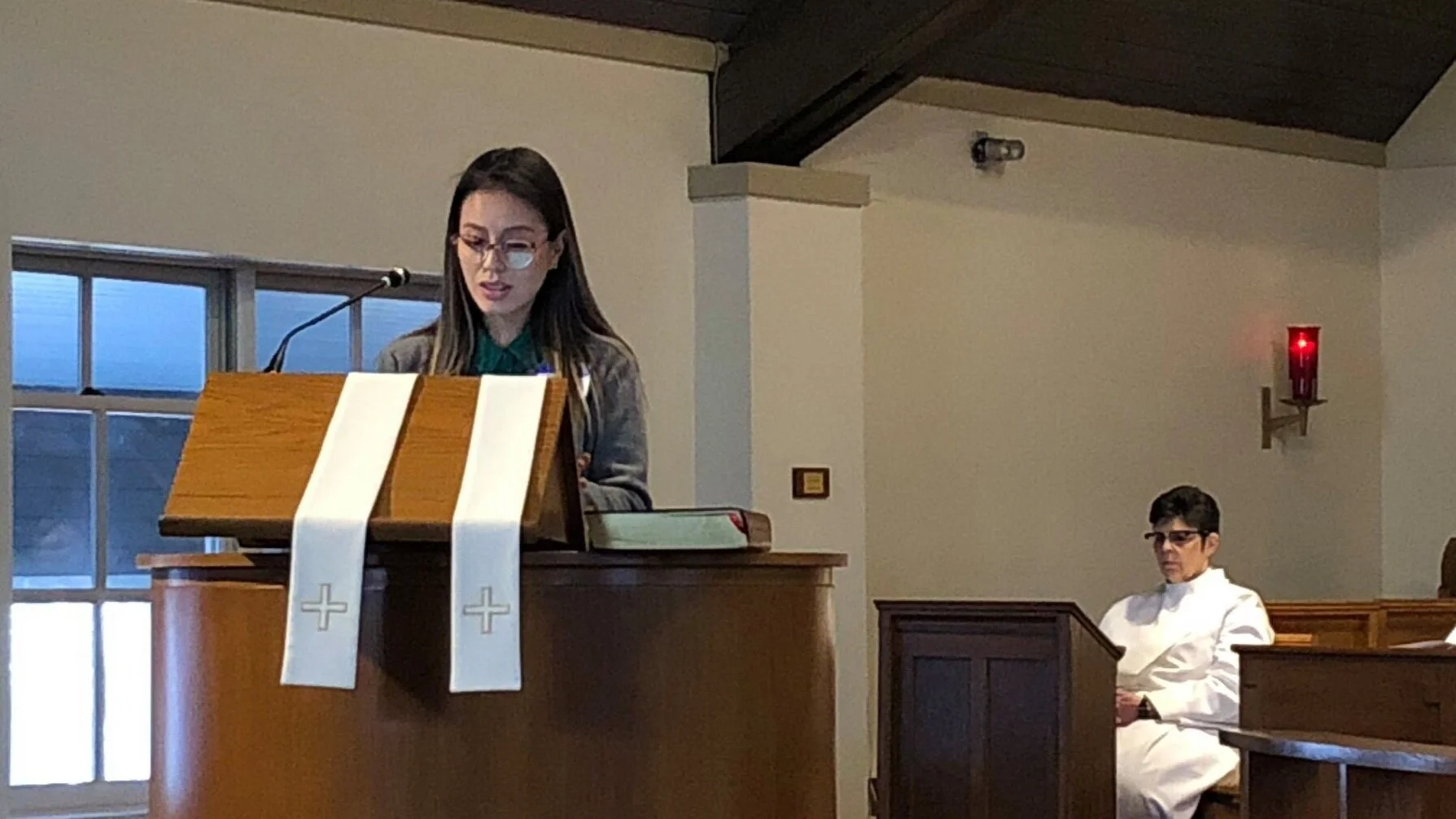
Viviana Cordero Garcia, Esperanza Academy
Viviana Cordera Garcia shares how love, community, and belonging have guided her personal journey and inspired her work as Director of Graduate Support at Esperanza Academy.
Thank you so much for the opportunity to be here this morning. I’m mindful of how sacred this time in the week is to everyone. Sunday is a time that we come together as a community, a time of rest, a time of family, a time of harmony, and most importantly a time of love. I am honored that you have allowed me into this beautiful space with you on this Sunday morning. My name is Viviana Cordero Garcia, and I am the Director of Graduate Support Program at Esperanza Academy, a tuition-free, independent middle school for girls in Lawrence, Massachusetts. I want to thank this congregation for its support of our students, our school, and our mission. Thank you so much for welcoming me to the Church of the Good Shepherd.
Today, I am well into my second year at Esperanza Academy and my first year as Director of the Graduate Support Program, and both as a human being in this world and an educational professional, it’s been a transformative time in my life. The stories I share today are connected to themes of service, love, community, and belonging… all of which are embedded in my personal journey in education. Before I tell you about our Esperanza community, our graduates, and our philosophy in Graduate Support, I want to share a little bit of my story with you.
I was a toddler when my mother and I arrived in New York City. Although most of our family lived in Ecuador, my mother knew that the American dream was one that she had to pursue for herself but mostly for me. We lived in various Queens communities before settling in Jackson Heights, a vibrant immigrant city much like Lawrence. We spoke little English but figured it all out together. As a single parent, my mother worked multiple jobs but always found time to make dinner, eat with me, and teach me to pray at night. My mother worked hard to learn everything she could about how to raise a young woman in the city, raise herself, and continue to support her 8 siblings even from countries apart. When my uncles, aunts, and other relatives began to immigrate to New York, she welcomed them, happily opened the doors of our one-bedroom apartment, fed, facilitated job searches, and did it all with such grace and love. From an early age, I learned what it meant to give, to serve others, and do good work that is not just for my own benefit but for the benefit of others.
My mother instilled in me values such as learning, service, kindness, determination, and empathy. She exemplified these same values countless times and when I embarked on my college journey, these values helped me stay resilient. Shortly after earning my bachelor’s degree in 2009 from a small private liberal art’s institution, I learned that my college experience and challenges were not unique. My experiences as an Ecuadorian immigrant, an English-language learner, first-generation college student from a low-income background and a single-parent household, led me on the path to becoming an educator.
After college, I was provided opportunities to work at educational nonprofits and grassroots organizations. In my mid-20s, I found myself again reflecting on the importance of community and service. My community helped me to identify my gifts and passions as I worked directly with youth. My identities helped me relate to others and build relationships, and I began to trust that God had given me unique gifts, a passion for education and equity, and the opportunities and communities to exercise these gifts.
The more work I did with underrepresented youth across the country, the more I felt I needed to grow my knowledge in the education field. Through the Institute for Recruitment of Teachers, I received a fellowship opportunity that led me to earning my Master’s in Higher Education at a large research institution. I was able to develop my facilitation skills and knowledge in education systems. My previous work in New York City informed my studies of equity and inclusion and systems of oppression in graduate school. Throughout those two years, I grew more aware of and inspired by our power, strength, and resilience to create change by working toward a vision of justice.
My move to Lawrence and arrival at Esperanza marked the beginning of a beautiful journey for me. I began to see clearly that my educational journey and life experiences have allowed me to live out my call to love in every sphere of my life… This was my vocation.
At Esperanza Academy, my role allows me to work with Black and Brown girls from the time they enter middle school to when they are considering college and career opportunities after completing post-secondary programs. Together we discuss best-fit schools, how to navigate school resources in high school and beyond, their roles in their families, complex familial pressures, attending school as a first-generation student, and what it means to be comfortable in their own skin. At Esperanza, we think critically with students, faculty and staff, and community partners about the inequitable social patterns and institutions around us, analyze forms of oppression, practice restorative justice, and then prepare to build community to make our relationships stronger and spaces more just.
Esperanza is a community I am proud to be a part of because I am not doing this work alone- and we know social justice work is collaborative at its core. Our team believes that girls from Lawrence deserve a good education, should feel empowered and be provided the necessary tools to go into the world to be themselves, happy, and successful. This past year, I witnessed our students being resilient, taking risks, growing, and returning to Esperanza to pay it forward. The following stories are just a few of the many we are proud.
Sarah, a recipient of a full tuition scholarship at Brooks School, has maintained a high GPA and joined the volleyball team during her first semester of high school. She has just discovered crew and cannot wait to try out for the team this spring.
Aleene, another incredible young woman, was awarded a scholarship to attend Waring School, a French immersion independent school. She is already planning her trip to France where she will get to practice her French speaking skills for the four weeks she is there.
Keahilani joined the Sparhawk community as a tenth grader this year and has impressed the faculty and staff there with her ability to organize. She leads community service projects every month and has created the school’s first dance team. 14 peers have joined the team already.
Katherine is in her final year at Holderness School and worked hard to complete the long college application process earlier than most this past fall. She has already received acceptances to St. John’s University, Fordham University, Clark University, and a couple of the University of Massachusetts schools.
Natalie, who is in her third year at Centre college on a full tuition Posse scholarship, is living and studying in Japan this semester. She’s preparing to pursue a law degree after college and is excited to be learning how laws are created and governments work in other countries. She’s shared that Esperanza taught her to take advantage of all opportunities and get out of her comfort zone. Nat has not left Japan yet and is already planning on returning after college.
Nurys is graduating from the College of Holy Cross with honors this year. During her winter break she applied to and was offered a job again at the Lawrence Mayor’s office as an aid. She serves as a community liaison and feels blessed to be able to use her bilingual skills to give back to the Lawrence community.
Our graduates are out in the world being rock stars.
In many ways, my role as Director of Graduate Support is my best one yet. I am able to provide support AND celebrate our girls for their community cultural wealth. Through our Graduate Support Program’s 12-year commitment to all girls, my team and I provide socio-emotional and academic support for all our students and graduates. This is a big responsibility and one I do not take lightly. I am motivated to continue this work by Sarah, Aleene, Keahilani, Natalie, Katherine, Nurys, and the other 154 graduates and their families.
I am reminded that God places us in particular communities of believers. That He expects us to live interdependently, so those who benefit from our vocational living also invest in our vocational development with their wisdom and affirmation. I realize that Esperanza girls benefit from my vocational living and also recognize that they make up one of my communities of believers. They constantly provide me with the wisdom and affirmation I need to do this labor of love.
My commitment to creating more inclusive spaces and more positive student experiences has been strengthened throughout these two years at Esperanza. It has been strengthened through every conversation, call, text, and hug from graduates, through my relationships with community members and supporters of Esperanza, and through my experience of living and working in Lawrence, a place that, much like my beautiful Jackson Heights in Queens, NY, is full of immigrants, light, resilience, and hope. There is truly nothing more beautiful than being part of a community that perseveres.
As I think about our mission at Esperanza, our students, our families and our work in Graduate Support, I am reflecting on these words from first John chapter 3 verse 18. I invite you to reflect with me.
Dear children, let us not love with words or tongue but with actions and in truth.
Thank you very much.

Our choir rehearses Wednesday evenings at 7:15 pm.
Our choir rehearses Wednesday evenings at 7:15 pm.
I look forward with great anticipation to enriching congregational worship with music from our choir, as well as other voices and instrumentalists within our ranks! A present opportunity is upon us. The first Sunday of the month (until further notice) is Mission Service. The choir will be prepared to present a choral anthem, but I would like to encourage those soloists, guitarists, clarinetists, trios and more to also share their talents! Before we know it, the holidays will be upon us. Have you ever had the desire to sing with the choir but can’t commit to the whole church year? Well, you’re in luck! Join the Christmas Choir! Only four Wednesday rehearsals: November 27, December 4, 11 and 18, ages 14 and above. Please contact me with your particular talent and abilities for future services.
Christ’s love,
Deborah Colageo
classicaldeb@gmail.com